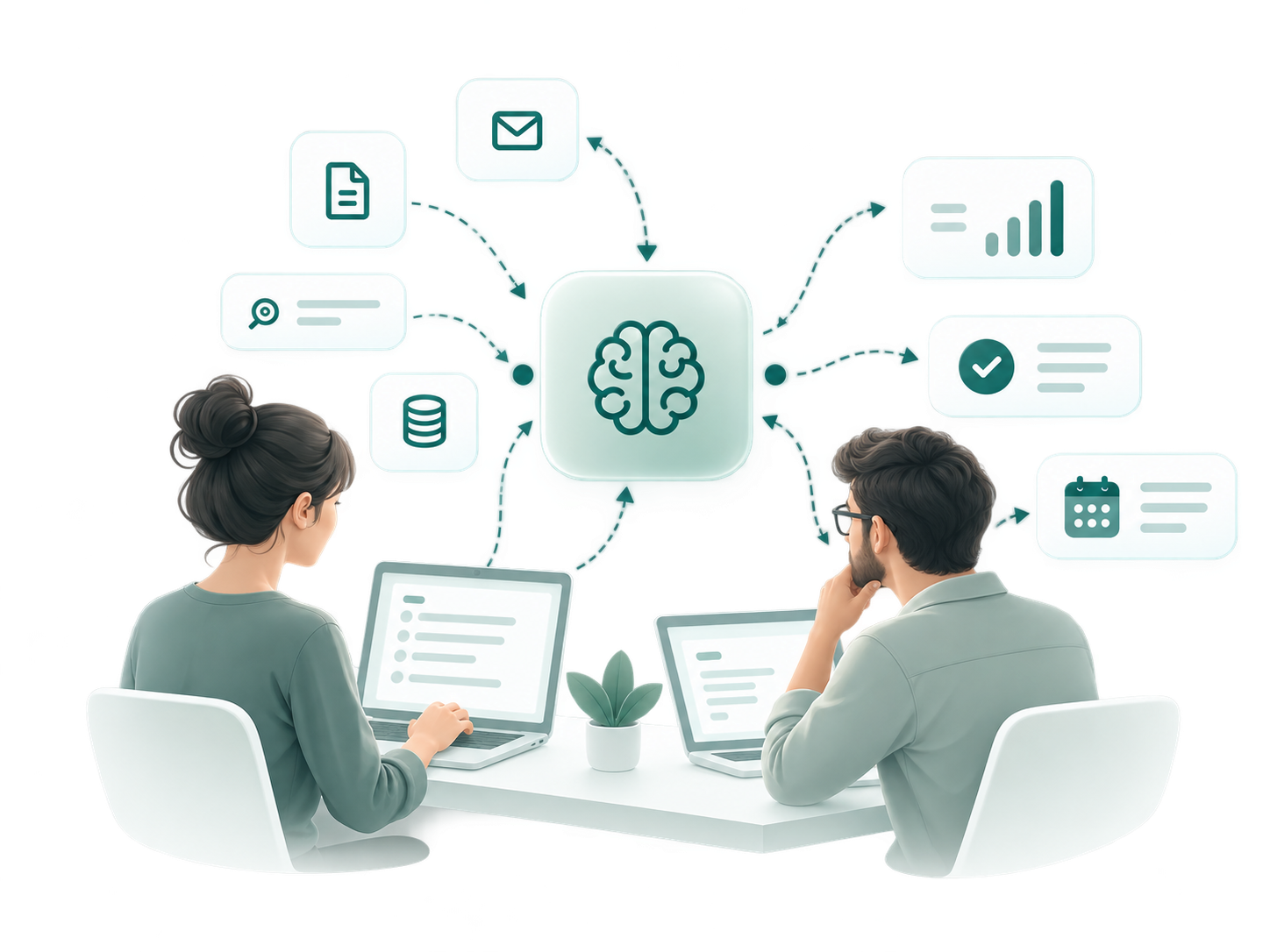
There is too much information to review manually
Employees spend time reading documents, messages, reports, and other text.

We identify where AI can genuinely help, connect it to your existing processes, and make it a practical part of everyday work.
Employees spend time reading documents, messages, reports, and other text.
People search through files, old emails, or internal instructions before they can respond.
Draft replies, summaries, descriptions, and documents are written from scratch again and again.
Letters, forms, PDFs, and scans contain information that has to be understood and processed.
Simple rules are not enough when the system needs to recognise context, intent, or meaning.
Employees use separate tools on their own, while the company has no shared rules or quality checks.
Works well when the rules are clear and predictable.
For example:
Useful when the first step is to understand the content.
For example:
We clarify what AI needs to understand, what information it may use, and what a useful result looks like.
We compare suitable models, data sources, access methods, and decide where human review is needed.
We test the solution on real examples, refine its behaviour, and explain how to use it safely.
We define which information the solution may use, where that information is stored, and whether it can be sent to a cloud AI service.
When needed, part or all of the solution can run on company-controlled infrastructure or with a self-hosted model.
Important decisions can remain with a person, while AI prepares information or suggests the next action.
For example, document analysis, reply drafting, or information extraction.
A dedicated interface, connection to company data, access rules, and integration with other systems.
Several data sources, integrations, roles, or AI capabilities in one solution.
No. The right setup depends on the task. It may use a cloud AI service, an API, or a local model.
Yes. The solution can search and use approved company data while respecting the access rules you define.
Yes. A limited first version is often the safest way to test quality and usefulness.
That depends on the task and the data. We test the solution on real examples and add checks where mistakes would matter.
In many cases, yes. For sensitive data, we can consider a local or self-hosted model and keep more of the processing under your control.
Yes. We can begin with one task and add data sources, actions, or new capabilities when there is a clear need.
Tell us which work takes the most time or requires the most attention. We will help you decide whether AI is the right tool and how to use it safely.